

How Many Strands of Embroidery Thread Should You Use?


The answer to this question, like many questions in crafting, is both simple and a bit frustrating: as many as you want!
Standard cotton embroidery thread (also known as floss or 6-strand floss) is actually 6 strands of thread loosely twisted together. It's not plied (which is a way to twist threads together to create a thicker and stronger thread that's used on its own), but twisted together in a way that makes it easy to separate. For many projects, 2 or 3 strands gives you the thickness you might be looking for, and 3 strands is approximately the same thickness as Perle Cotton #8, which is another ubiquitous embroidery thread. If you are a cross stitcher, you are likely used to using 2 strands.
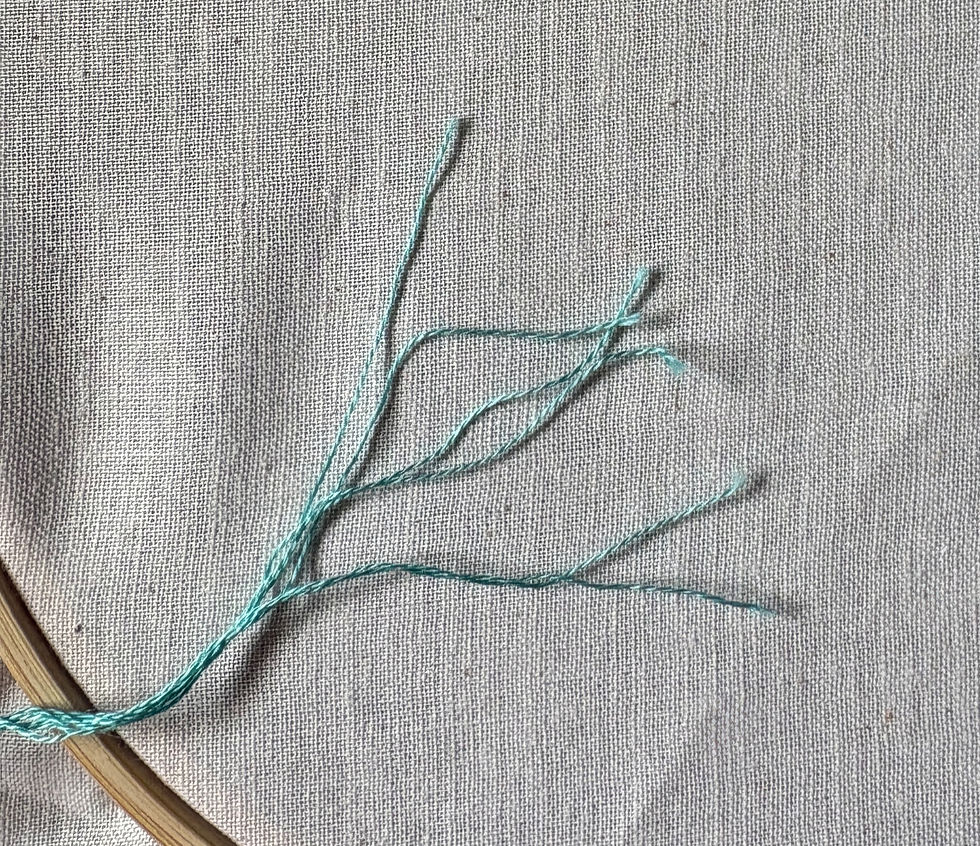
As you explore embroidery, we implore you to play with number of strands to give you the line you want. It's fun to see how different a stitch can look with a thicker or thinner thread. The photo below shows a strand of floss, with the ends pulled apart so you can see the separate strands. It's really easy to pull apart. Our big advice for avoiding tangles is to go slow and use thread gloss (here's why)!
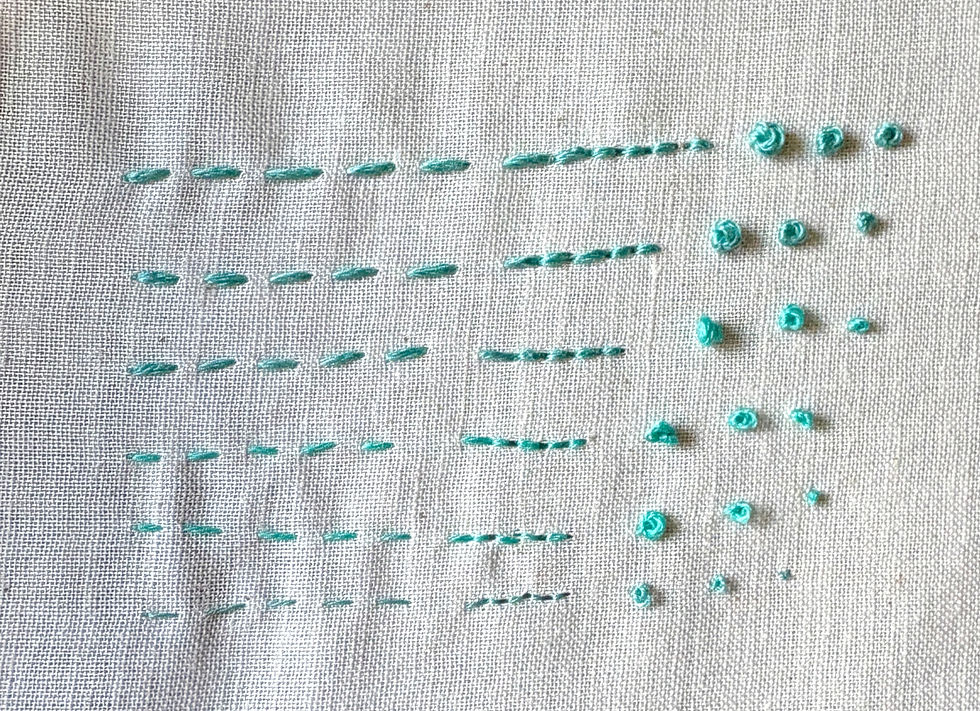
As an exercise, we've created a sampler of thread thicknesses in Running Stitch, Back Stitch, and French Knots, so you can see what each stitch looks like with different thicknesses/number of strands.
The top row is stitched with 6 strands of embroidery thread. You can see these stitches are thick and dense. The French knots, the first made with three wraps, the second with two, and that last knot with one wrap around the needle, are round, full, and sit away from the fabric.
As you look down the rows, the next is stitched in 5 strands, then 4 strands, then 3 strands, then 2 strands, and finally one strand. As the strands become fewer, the stitches become finer and more delicate. With fewer strands of thread, these stitches are also more flush with the fabric than those made with more strands of thread.
There's isn't a right or wrong answer of how many strands of thread to use when embroidering. Don't let anyone tell you differently! It's entirely up to you and you can use as many or as few as you'd like.
The number of strands you choose to use can change the aesthetic and texture of your embroidery. If you want a thick chunky embroidery or lots of texture, use more embroidery thread. If you want a more delicate embroidery or are stitching a more detailed embroidery, opt for few strands of thread. The pepper shown below is a great example of the same stitch in different thicknesses giving a markedly different look; the outer pepper is stitched with all 6 strands, the next layer in is stitched with 3 strands, and the inner-inner pepper is stitched with 2 (and, I used both of the oranges, one strand of each, for a variegated effect!) The stitch I used is the Split Back Stitch, which has become a recent favorite!

I believe it's important to experiment and try out different threads options. Thread isn't permanent- you can always take it out and try something else.


Comments