

What Type of Embroidery Kit Is Right for You?


Have you been wanting to try hand embroidery? Or maybe get back into needlework?
Are you unsure of where to start? Or overwhelmed by all of the options available these days?
I'll be the first to admit I get decision paralysis when there are too many options in front of me. Sometimes it's fun to pick and choose from an assortment (mostly when I have an idea in mind of what I'm looking for). But other times it's just easier if someone tells me what to get and why. This is doubly true when it comes to deciding on where to eat for dinner.
Figuring out the right stitch kit for you can take a little while. This type of question is something I'm often asked at craft fairs and I'm more than happy to walk makers through the options and help them find the right kit for themselves or as a gift. I want to start you up for success and have fun on your stitching journey. Let me walk you through the embroidery kit possibilities!
How to figure out which embroidery kit is right for you
When determining which embroidery kit you might want to stitch it's important to keep in mind the kit skill level, project size, materials provided, and design transfer method.

Beginner Embroidery Kit 
Intermediate Embroidery Kit 
Advanced Embroidery Kit
Skill Level
Embroidery kits come in a range of skill levels. Some are labelled beginner, intermediate, and advanced, where as others might be a 1, a 3, or a 5. This skill level rating is dependent upon the designer or maker of the kits. There is usually a helpful key that shares a kit about each skill level on the kit or the website, but that's not always the case and everyone ranks kits differently. There isn't a standardized ranking system for embroidery kits.
MCreativeJ embroidery kits are available in beginner, intermediate, and advanced options. Our kits are categorized so that each rating takes into account the types of stitches used, the complexity of the design, and time it would take to complete.
Beginner Kits: includes all needed material, use 3-5 beginner-friendly stitches, usually finished in ~4-6 hours.
Intermediate Kits: includes all needed materials, builds upon beginner-friendly stitches while also using layered and somewhat trickier stitches, can use a wider variety of stitches than a beginner kit, usually finishes in ~6-10 hours
Advanced Kits: includes all needed materials, uses a wide variety of stitches, builds on embroidery stitch foundations to use trickier, textural and 3D stitches and techniques, usually finishes in ~10-15 hours
No matter what kit you choose to start with, each are designed to make embroidering as beginner friendly and enjoyable as possible.
With this being said, every maker has a different sense of what is beginner to advanced and comes with a different skill set. If you've never picked up a needle and thread, you might want to stick with a beginner kit. If have a background in other crafts but haven't embroidered before, you might be comfortable with a beginner or intermediate kit. If you've been embroidering for a while and want to just have fun or test your skills, then a beginner intermediate, or advanced kit could be something you enjoy.

Project Size
From giant table clothes to mini ornaments, kits are available in a wide range of sizes. Knowing what size project you want and have time to take on is important when picking out an embroidery kit. If the project is too big you might not finish the design or get discouraged. While small projects can offer more instant gratification, they also mean you're back to looking for your next embroidery project.
Size can also influence how easily you can work on your project. Smaller projects are more portable and could be done on a commute to work or while at a playground. Larger projects might need dedicated equipment like a hoop stand or be more cumbersome to move around.
When I design MCreativeJ embroidery kits I always try to keep the project sizes approachable in 4 and 5 inch circular hoops and 4x6 inch oval hoops. While the patterns can be detailed, the size is portable so that you can take it anywhere. Before becoming a full time artist, I often commuted to work. This gave me almost 2 hours of dedicated embroidery time each day!

Materials
Hand embroidery kits are usually complete kits that come with everything you'll need to complete a project. Each kit and its materials will vary from designer to designer. But having everything in the kit isn't always the case. This is why it's important to look at what is included in the kit. If you already have some hand embroidery materials, a kit without a hoop might not be an issue, however, for someone just starting embroidery that would be an additional item they would need to purchase along with the kit.
Along with materials, instructions are an important part of any kit. Knowing how they're provided can be an integral part of the kit. Are they printed and included in the kit? Do you need to scan a QR code to download a PDF? Are all of the instructions videos? Depending upon how you like to learn and where you'll be embroidering these are all important factors to keep in mind. You wouldn't want to get an embroidery kit for a long plane ride, only to find out you had to download the instructions and a PDF and you don't have wifi to do that.
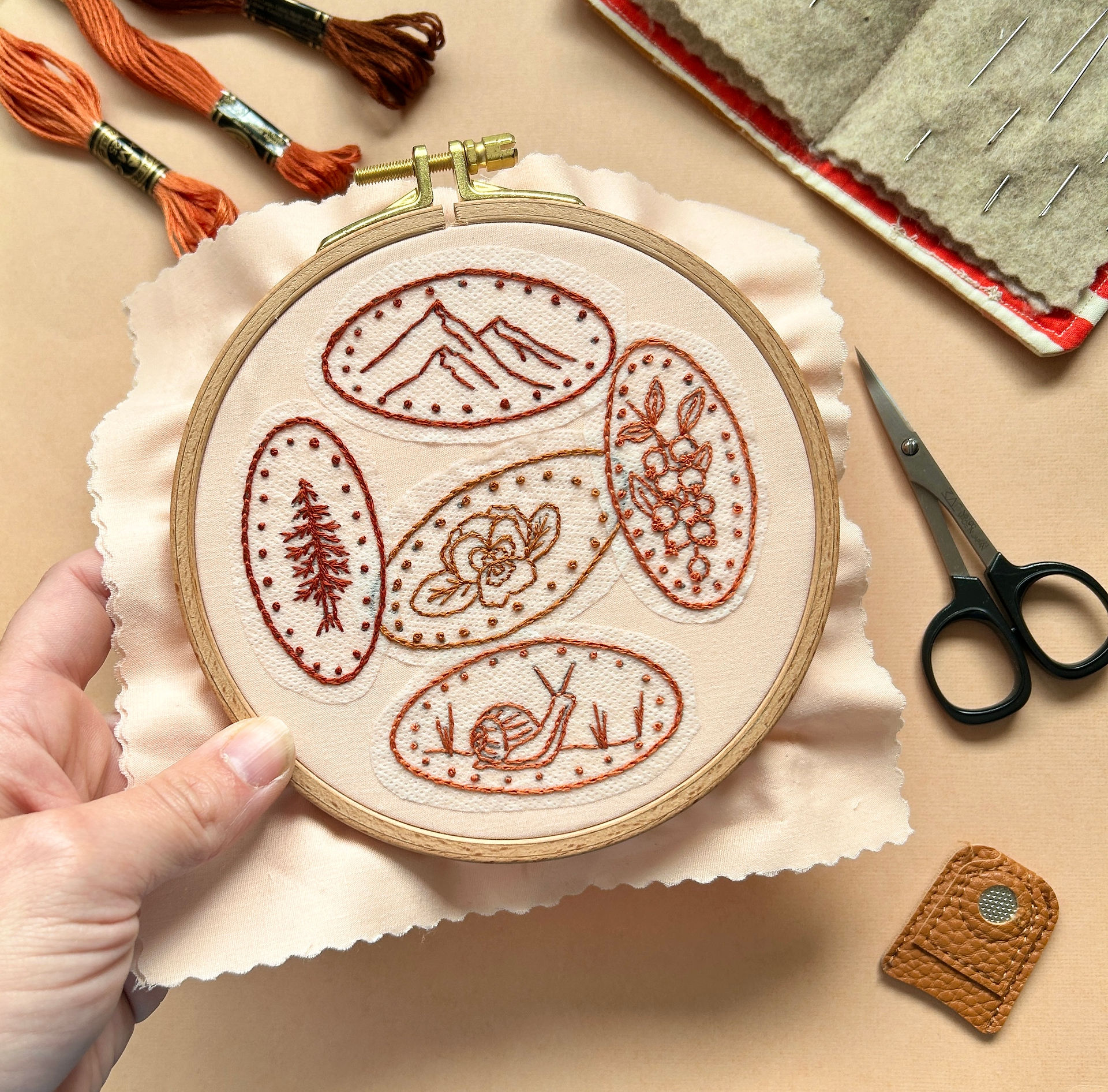
I always want to provide the highest quality experience possible, which is why MCreativeJ embroidery kits include a high quality beechwood hoop, a water soluble transfer design, quilting cotton fabric, full skeins of DMC embroidery thread, an embroidery needle, full color printed instructions with photos, a QR code to additional stitch videos, and backing materials.


Design Transfer Method
Another point to consider when picking out an embroidery kit is how the design is supplied for the project. Is it something you'll need to transfer onto the fabric? Printed onto the fabric? A wash-away pattern? While you might not know which of these design transfer methods you like with your first embroidery kit, it's definitely something to consider for your second, third, and fourth projects.
Transferring an embroidery pattern is a great skill to know how to do, but not something everyone enjoys doing, myself included. The upside to needing to transfer the pattern, is that you can use the pattern again and again. The downside is that it can mean needing additional tools, like a transfer pen/pencil, light box or access to a well-lit window before you can even start your project.
A pre-printed fabric pattern is a great option to start stitching right away. The pattern is usually easy to see on the fabric and clearly indicates the design. However, there are some downside to pre-printed patterns. These include:
You cannot change any part of the design because it is already permanently on the fabric.
If you don't follow the design exactly as it is printed, you will see the pattern underneath the stitching.
Some printed designs can show through lighter thread colors, highlighting the fact that the embroidery was created from a pattern.
Water soluble patterns are what I include in MCreativeJ embroidery kits. I love these because they're the most forgiving transfer option. You essentially, peel off the backing, stick it onto the fabric, stitch away, and rinse the pattern off when you're done. I always like to say that because the pattern rinses off the fabric, no one will ever know if you ever followed the pattern or not. While this is my preferred transfer method, this isn't to say there aren't downsides to it as well. The sticky backing can make sometimes the embroidery needle tacky and the transfer pattern can be slightly stiffer to stitch through than fabric alone.


Comments